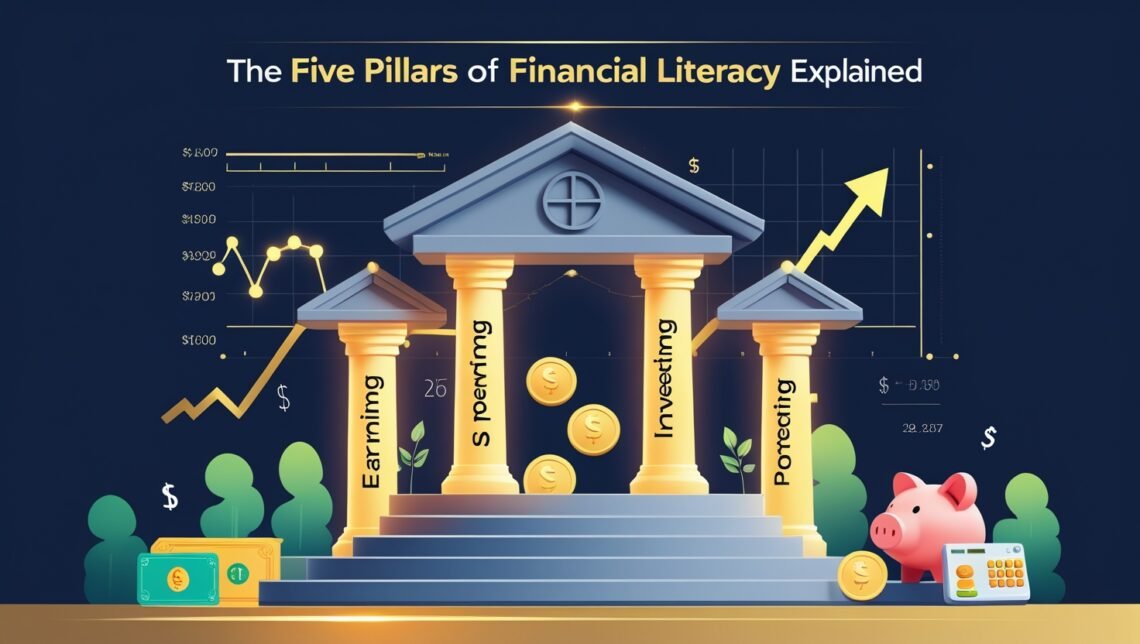
Financial literacy means that you should have correct knowledge about your money, you should know how money is earned, how it is spent, how it is saved and invested, and if required, how to borrow in a responsible manner. All these together form the five pillars of financial literacy. In today’s time, where everything is related to money, financial literacy is necessary for every person, whether he is a student, employee, business owner, or retiree. Everyone takes financial decisions at some stage or the other, and if these decisions are taken without knowledge, then they can land a person in trouble. Financial literacy makes a person self-reliant and makes them understand that he is responsible for their financial future.
In this blog, we will discuss those five basic aspects that are important for every person to understand. These are the pillars: earning, spending, saving and investing, borrowing, and a foundation made of the right balance of all these. If a person understands these pillars properly, then he can make the best use of his money, can stay away from stress, and can live a secure life. In today’s times, the knowledge of these pillars is not only helpful but has become essential. Every person should learn these basics and apply them in their life.
Earning: Knowing Where Your Money Comes From
Earning is the first and most basic pillar of financial literacy. It means that you understand where your money comes from and what kind of income you get. Whether you are doing a job, running a business, or doing freelance work, it is important to understand whether your income is stable or not, and what you are doing to increase it. Earning is not just a name for earning money, but also a process of upgrading your skills. If you increase your value by learning new skills in your field, you can earn more money. Apart from this, understanding your pay slip or salary structure is also a part of earning. Every person should know how much tax is being deducted from their salary, what the allowances are, and what the net income is. Many people feel happy just by seeing the gross salary, but when there are deductions then they do not get an idea of the actual income.
Nowadays, the concept of passive income has also become quite popular, in which you can earn money without doing full-time work, like online business, investments, or rental income. The pillar of earning also teaches that one should not depend on a single source of income. Having multiple streams of income is important in today’s world so that you remain financially stable in every situation. The right knowledge and planning for earning will take you towards financial freedom.
Spending: Making Smart Choices with Your Money:
Spending is one such thing that happens every day, but if it is not done with understanding, it can become the biggest financial problem. This pillar of financial literacy makes us understand whether every penny we spend is either beneficial or harmful. Often people spend money without thinking and understand their desires, and regret it later. The first rule of spending is that you should understand the difference between needs and wants. Needs are those things which are necessary, like rent, food, and electricity, but wants are those things which are only for luxury or comfort, like branded clothes, expensive gadgets.
Unless you prioritize your expenses, you cannot save or invest. In today’s time, digital shopping, credit cards, and EMI options have made spending easy, but these provide only temporary ease and can become a long-term burden. Hence, it has become very important to make a spending plan, note down daily expenses, and prepare a monthly budget. When you spend money in a disciplined way, you get close to your goals. Before every expenditure, one should think whether it is necessary, whether it fits in the budget, and whether it will have an impact on the future. The right way of spending makes life easy and saves from unnecessary stress.
Saving and Investing – Planning for the Future:
Saving and investing are two elements of financial literacy that make the future secure. Saving means that you keep some part of your income aside every month, so that money is available in case of an emergency or for a future goal. Saving habits are very important, but just saving money is not enough. It is equally important to grow that money, which we call investment. Investment means that you invest your money in a place from which you get returns, like stocks, mutual funds, gold, real estate, or retirement plans. When you understand both saving and investing in the right way, you create a financial cushion for yourself.
Every person should maintain an emergency fund that can cover the expenses of at least three months from now. After that, if money is saved, it should be invested so that it can save itself from inflation and increase in value. While making decisions on saving and investing, one should also estimate the risk and time frame. Nowadays, many online tools and apps help people set their investment goals. The future is secure only when you prepare today. Therefore, saving and investing are important for every person so that they can handle his needs, dreams, and retirement easily.
Borrowing – Using Credit Responsibly:
Borrowing means that you are taking money from some source, which you have to return later, often with interest. This can be a credit card, a personal loan, or even an education or car loan. This pillar of financial literacy makes us understand that borrowing is necessary, but if it is not taken responsibly, it becomes a huge financial burden. When people take loans or use credit cards without understanding, they face difficulties at the time of repayment. First of all, it is important to understand that borrowing should be done only when there is a clear purpose and repayment plan. You should know what the interest rate, repayment duration are, and whether your monthly income can afford that repayment or not.
Your credit score is also an important factor in borrowing, which decides whether you will get the loan or not, and at what rate. If you do not make the payment on time, your credit score drops which creates more problems in the future. Responsible borrowing means that you should take only as much loan as is necessary and as much as you can easily repay. When borrowing is done smartly, it can help you financially, but when it is misused, it results in stress, loss, and mental pressure.
Conclusion:
Understanding and applying these five pillars to your life is the first step to building a strong financial foundation. From earning to spending, saving, investing, and borrowing, each pillar plays a unique role. When a person creates a balance in these pillars, he avoids financial problems and achieves his goals easily. In today’s era, just earning money is not enough; it is very important to understand it, use it in the right way, and plan for the future. Financial literacy makes you understand that every financial decision has an impact not just on today but also on your tomorrow.
That’s why every person should work on their financial education and include these pillars in their routine. When you make decisions after considering every aspect of money, you are creating a better future, not just for yourself but also for your family and future generations. Every person, be it a student or a retiree, if they adopt these five pillars, they can live an independent, stable, and confident financial life. You should start your journey of financial literacy from today itself, so that you do not have to be dependent on anyone tomorrow.
FAQs:
1. What are the five pillars of financial literacy?
The five pillars of financial literacy are earning, spending, saving and investing, borrowing, and maintaining a balanced financial approach. These pillars form the foundation of managing personal finances wisely, helping individuals make informed decisions that lead to financial stability and independence.
2. Why is it important to understand where your money comes from (earnings)?
Understanding your source of income helps you plan better for the future. It includes knowing your salary structure, tax deductions, and exploring ways to increase your earnings through skill development or passive income. Recognizing and diversifying income streams ensures financial security in uncertain times.
3. How can I control my spending habits?
Controlling spending begins with identifying the difference between needs and wants, creating a budget, and tracking daily expenses. Avoiding impulsive purchases, using credit responsibly, and prioritizing necessary expenses over luxury help in reducing financial stress and allow room for saving and investing.
4. What is the difference between saving and investing, and why are both important?
Saving is setting aside money for short-term or emergency needs, while investing is putting that money in financial instruments to grow it over time. Saving builds a safety net, while investing helps beat inflation and grow wealth. Together, they provide both financial security and long-term prosperity.
5. When is borrowing considered responsible, and how can I avoid debt traps?
Borrowing is responsible when it is based on a real need, with a clear repayment plan and understanding of interest rates. One should only borrow what they can repay comfortably and make timely payments to maintain a healthy credit score. Avoiding unnecessary loans and credit misuse prevents long-term financial strain.